Address
Factory-B-19, additional Midc, Yavatmal, Maharashtra, India
Work Hours
Monday to Saturday: 10 AM - 5 PM
Sunday: Closed
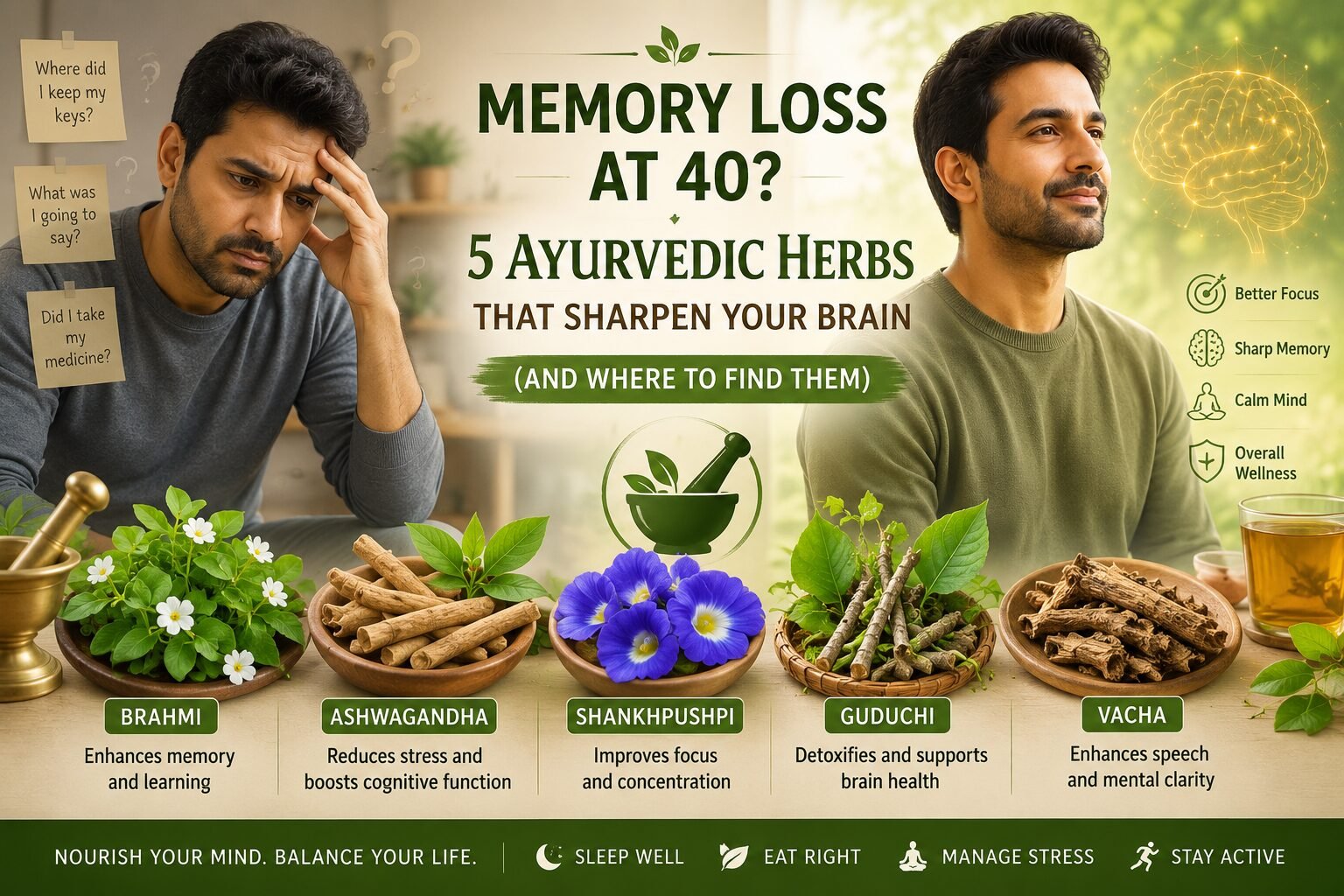
Memory loss at age 40 is not usually a disease by itself. In most cases, it is mild, temporary, and reversible. Memory loss is when your brain struggles to store, keep, or pull-out information it used to handle easily. It’s not one thing. It’s a spectrum.
There are three types that can be considered:
Walking into a room and forgetting why. Misplacing keys. Forgetting what you were about to say. This is the most common “age 40” complaint.
Trouble remembering what you ate yesterday, details of a conversation this morning, or whether you took your meds.
Forgetting names of old friends, skills you’ve known for years, or big life events. This one’s less common and more serious.
Common Causes of Memory Problems Around 40+
Normal & Reversible Causes:
Stress reduces focus, which affects memory. Stress with multitasking causes your brain records less when cortisol is high. Too much information while multitasking causes poor to recall. High cortisol shrinks the hippocampus, your memory center. Brain never fully records the information. Phone pings kill memory formation.
Sleep is critical for memory storage. Deep sleep is when memories get filed. Poor sleep causes poor filing.
Someone can feel like memory loss, most of the people call it brain fog.
Thyroid issues or early hormone shifts are responsible for poor memory. Perimenopause and andropause can scramble focus and recall. Estrogen and testosterone drop affect recall and word-finding.
Your brain runs on glucose. Spikes and crashes fog up recall. Diabetes and insulin resistance starve brain cells or flood them with sugar.
Especially Vitamin B12 & D Nutrient gaps or omega-3s hit memory hard. Super common after 40, especially vegetarians. Causes brain fog and forgetfulness. Low Vitamin D is linked to slower processing speed.
Lack of exercise, unhealthy diet, alcohol, smoking are some causes that has to be considered for memory loss. Long-term alcohol use causes short term memory loss. Even 1-2 drinks daily can impact recall over time. Dehydration drops focus and short-term memory.
Side effects of medications can be responsible for poor memory. Antihistamines, BP meds, statins, benzos, and some antacids can blunt memory as a side effect.
Forgetting where you parked but remembering later.
Tip-of-the-tongue moments.
Forgetting names but remembering later
Misplacing keys or phone occasionally.
Forgetting small details under stress.
Being distracted but functioning well at work or home.
You get lost in familiar places.
If forget how to use a TV remote,
When loved ones notice personality changes.
Forgetting important events or conversations.
Repeating the same questions frequently.
If memory issues persist for more than 3–6 months or affect daily life.
At 40, 90% of memory complaints trace back to stress, sleep, B12, thyroid, or sugar. The other 10% need a doctor to rule out bigger stuff. If it’s sudden, getting worse fast, or affecting work and relationships, don’t guess. Get checked.
A daily lifestyle guided by Ayurveda helps memory loss naturally by addressing the root causes such as stress, irregular routine, poor digestion, and nervous system imbalance rather than only the symptoms. Ayurveda believes memory depends on a calm mind, strong digestion, and well-nourished brain tissue.
Sleep 7–8 hours daily. Adequate sleep, reduced screen time, mindful thinking, and exposure to natural light further strengthen concentration and recall.
Exercise regularly. Even daily walking helps. Following a regular daily routine waking, eating, working, and sleeping at fixed times stabilizes Vata dosha, whose imbalance commonly leads to forgetfulness, anxiety, and mental overload.
Simple habits such as oil massage (abhyanga) with sesame or Brahmi oil daily or a few times a week nourish nerves and improve circulation to the brain.
Eat brain-friendly foods such as nuts, fruits, vegetables, fish. Fresh, warm, home-cooked food with healthy fats like ghee, nuts, and seeds—supports digestion and provides steady energy for brain
Reduce stress with the help of meditation and breathing exercises. Pranayama and meditation reduce stress hormones, improve attention, and enhance oxygen supply to the brain.
Stay mentally active. Do some activities such as reading, puzzles, learning new skills.
Memory loss around the age of 40 because of imbalance in the doshas, especially Vata, along with mental fatigue, stress, poor digestion, and inadequate nourishment of brain tissues.
According to Ayurvedic principles, the mind and memory are governed by clarity, and when lifestyle stress, irregular sleep, anxiety, or improper diet disturb this balance, cognitive functions like concentration and recall can weaken. Ayurveda helps by focusing on rejuvenation, which aims to nourish the brain, calm the nervous system, and improve mental clarity through herbs such as Brahmi, Ashwagandha, Shankhpushpi, and Guduchi.
These ayurvedic can be helpful along with practices like meditation, pranayama, adequate sleep, and a sattvic diet rich in natural fats and antioxidants. Ayurveda emphasizes long-term mental health, stress management, and strengthening brain function naturally, making it especially suitable for age-related or stress-induced memory decline when followed consistently under proper guidance.
Experiencing forgetfulness or reduced concentration around the age of 40 is quite common, often due to stress, irregular lifestyle, lack of proper sleep, or mental overload.
Ayurveda explains this as an imbalance of vata dosha and weakening nourishment of brain tissues. The good news is that Ayurveda offers gentle, natural solutions through time-tested herbs known as brain rejuvenators.
Here are five powerful Ayurvedic herbs that help enhance memory, focus, and mental clarity naturally.
Brahmi is the most revered herb for brain health in Ayurveda. It enhances memory retention, learning capacity, and concentration by improving neural communication. Brahmi also calms the mind, reduces anxiety, and protects brain cells from oxidative stress, making it ideal for age- and stress-related memory decline. It helps to nourishes brain cells, improves recall, and calms the nervous system. It is best for age-related memory loss, mental fatigue, and overthinking. It helps to improve mental clarity and reduces stress-related forgetfulness.
How to take:
Mix ½ teaspoon Brahmi powder with warm milk or water. Drink it before going to bed.
How to take:
Take ½ teaspoon daily, preferably in the morning.
How to use:
Gently massage Brahmi oil on scalp 2–3 times a week. Improves blood circulation to the brain, promotes calm sleep, reduces anxiety. Do it before bath.
Ashwagandha is a powerful adaptogen that helps manage stress, one of the biggest causes of memory problems at midlife. It supports nerve regeneration, improves focus, and reduces mental fatigue by balancing cortisol levels. A calm nervous system allows the brain to function more efficiently. It reduces Stress and Cortisol. Chronic stress increases cortisol, which can damage the hippocampus (the brain’s memory center).
Ashwagandha is an adaptogen, meaning it helps the body manage stress. Ashwagandha contains active compounds called withanolides. These compounds help protect neurons from damage caused by oxidative stress and toxins. It helps to improve attention and processing speed. Brain inflammation is linked to memory loss and neurodegenerative diseases. Ashwagandha reduces inflammatory markers in the nervous system. Ashwagandha improves sleep quality and reduces insomnia.
Take 300–600 mg per day of standardized extract. Usually taken once or twice daily. Benefits are typically seen after 6–8 weeks. It should be taken under experts’ guidance.
Traditionally used to improve intellect and calm mental restlessness, Shankhpushpi enhances attention span, learning ability, and recall power. It is especially beneficial for people experiencing memory loss due to anxiety, overthinking, or disturbed sleep. Shankhapushpi has shown pro-cognitive effects in preclinical and limited human studies, improving learning, recall, and working memory. It may enhance cholinergic activity, which is central to memory formation and attention. Chronic stress and anxiety impair memory.
Shankhapushpi exhibits anxiolytic (anti-anxiety) and calming effects, helping normalize stress hormones like cortisol. This calm-alert state improves focus and retention. Memory loss is linked with oxidative stress and inflammation in brain cells. Shankhapushpi contains alkaloids, flavonoids, and coumarins that protect neurons and reduce inflammation. Evidence suggests modulation of serotonin, dopamine, and GABA, supporting mood, sleep, and cognitive stability—all essential for healthy memory.
Powder:
Take 1–3 g of powder once or twice daily with milk or with honey before going to bed.
Capsules/Tablets:
Take 300–500 mg extract, 1–2 times daily after food.
Take 2 tablespoons of syrup with water before going to bed.
It should be taken under experts’ guidance.
Guduchi works by strengthening overall immunity and improving digestion, which Ayurveda considers essential for proper brain nourishment. It supports mental clarity by reducing inflammation, detoxifying the body, and ensuring steady energy flow to the brain. Guduchi contains bioactive compounds such as alkaloids, diterpenoid lactones, polysaccharides that show antioxidant, anti-inflammatory, and anti-apoptotic effects in the brain. These actions protect neurons from damage linked to aging and neurodegeneration, helping preserve cognitive function.
Preclinical studies show Guduchi extracts improve learning and memory retention in animal models using tasks like maze tests. Benefits are associated with better hippocampal plasticity, a key region for memory formation. Guduchi acts as an adaptogen, reducing stress-induced cognitive impairment. In sleep-deprivation models, Guduchi improved cognitive performance, reduced anxiety, and normalized stress markers. Chronic neuroinflammation contributes to memory loss.
Guduchi suppresses inflammatory cytokines and microglial activation, which are linked to cognitive decline. Memory depends heavily on acetylcholine signaling. Experimental evidence suggests Guduchi can enhance cholinergic activity and protect pathways involved in attention and recall. Reviews report benefits in experimental models relevant to Alzheimer’s and Parkinson’s disease, including reduced oxidative stress and improved cognition.
Guduchi powder:
Take 1–3 g per day with warm water or milk.
Capsules/tablets: Take 300–500 mg extract, once or twice daily.
It should be taken under experts’ guidance.
Vacha is known for sharpening intellect, speech, and clarity of thought. In very small and controlled doses (only under professional guidance), it helps remove mental dullness and enhances alertness, especially when memory loss is associated with sluggish thinking.
Preclinical studies show Vacha extracts improve learning, recall, and retention, with better performance in maze and passive-avoidance tests—indicating improved hippocampal function the brain’s memory center.
Vacha contains aromatic oils and phenylpropanoids such as α-asarone, β-asarone that show neuroprotective effects. These compounds help protect neurons from oxidative damage and support neuronal survival, which is crucial in memory decline and aging. Memory loss is often linked to oxidative stress and neuroinflammation.
Vacha shows acetylcholinesterase inhibitory activity, helping maintain acetylcholine levels are essential for attention, learning, and memory. It may also modulate GABAergic activity, which supports calm focus and reduces anxiety-related memory problems. Traditionally used to clear mental fog, improve alertness, and support speech and articulation, which indirectly aid memory and cognitive performance.
Vacha Powder:
Take 125–500 mg once or twice daily often with honey or ghee. It should be taken under experts’ guidance.
Key Takeaway
Memory loss at 40 is usually due to lifestyle, stress, or nutritional issues, not dementia.
The brain is still very adaptable at this age, and most memory problems are reversible.
Ujwala Ayurvedashram formulates Branocon and Assicon as a synergistic brain-tonic combination.